
It's a Constitutional optical illusion
How can the CIA get away with its un-American activities?

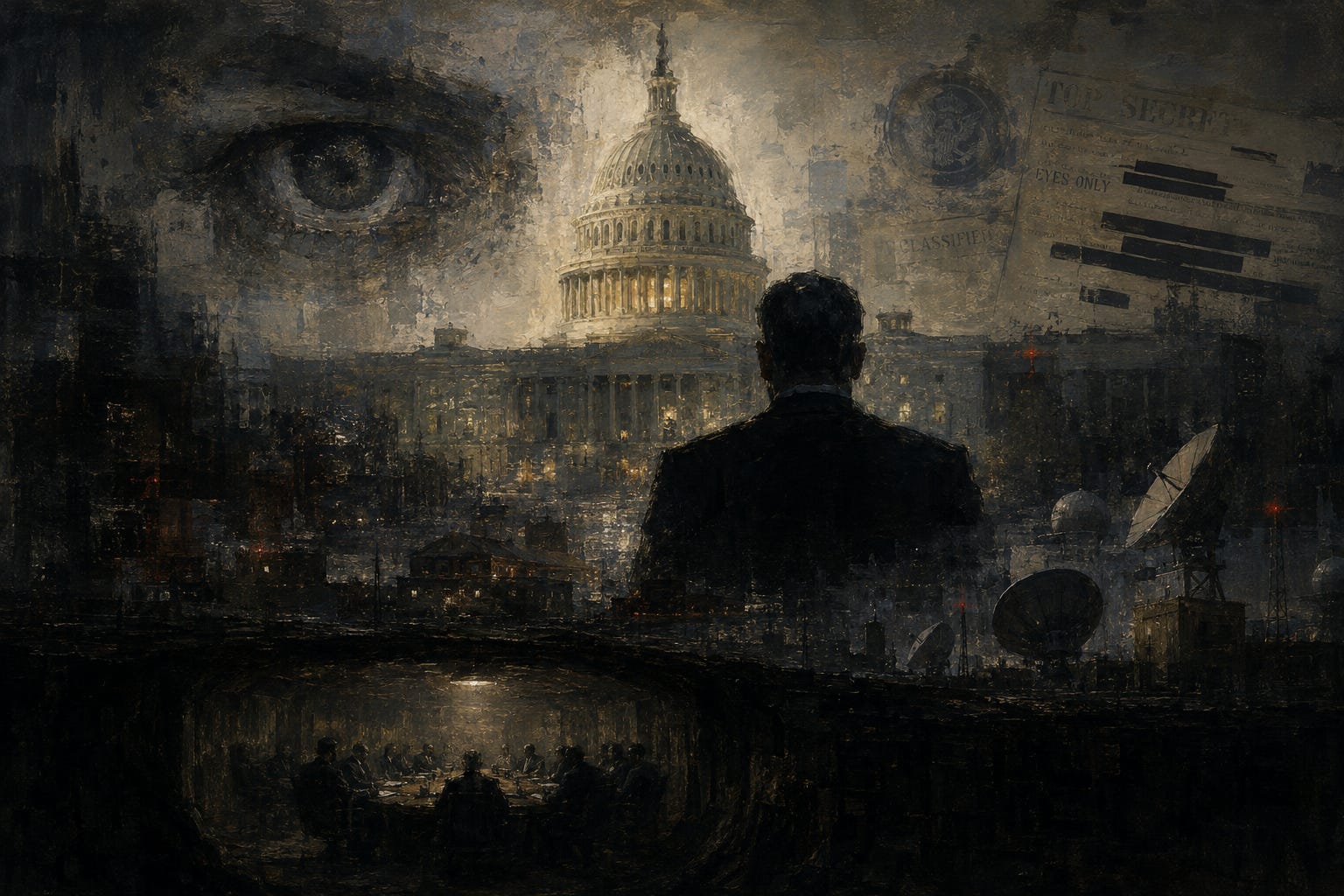
There is a persistent, almost comic mismatch between how democratic states describe themselves and how they actually behave when they think no one is watching.
On paper, the United States is a marvel of visible accountability: elections determine leadership, legislatures authorise spending, courts enforce limits, and public debate supplies legitimacy. Power, we are told, is legible. You can read the state like a book.
Except that periodically the book turns out to have a second volume — classified, unnumbered, and written in disappearing ink.
The Iraq War remains the clearest modern example, and it deserves to be remembered not as an “intelligence failure” but as something closer to intelligence malpractice with a body count. The assessments concerning weapons of mass destruction were not innocently mistaken; they were shaped, selected, and presented in ways that collapsed genuine uncertainty into political certainty. In the UK, the “dodgy dossier” became shorthand for how raw intelligence can be rhetorically laundered into justification for war:
In the United States, parallel processes produced parallel distortions — later acknowledged, occasionally regretted, and never once translated into anything resembling proportionate accountability. Hundreds of thousands died. The architects wrote memoirs.
A history of misadventure
Step further back and a recurring structure comes into focus. Not a single conspiracy — reality is rarely that tidy — but a repetition of intelligence-driven interventions whose consequences vastly exceeded their framing, and whose authors faced consequences vastly beneath their crimes.
• The CIA and MI6-backed 1953 coup in Iran:
• The 1954 Guatemala coup and subsequent destabilisation:
• Covert destabilisation during the Allende period in Chile
And lest anyone imagine this appetite was reserved for foreigners: COINTELPRO revealed sustained domestic surveillance and disruption of civil rights and anti-war movements — the state treating its own citizens’ political conscience as an insurgency to be broken.
Earlier still, MKUltra: behavioural experimentation on unwitting subjects, revealed only through congressional inquiry and the records that survived the agency’s attempt to destroy them:
And after Watergate, the Church Committee documented what the polite term “overreach” cannot quite contain — systemic lawlessness across multiple agencies, sustained over decades.
Post-9/11 counterterrorism then expanded the architecture into detention, rendition, and torture — rebranded, in the era’s great euphemistic achievement, as “enhanced interrogation.”
These episodes are heterogeneous. But together they suggest something structural, and structurally damning: intelligence capacity plus secrecy does not occasionally produce abuse. It produces abuse reliably, on a schedule, and then produces the impunity to match.
The constitutional optical illusion
Modern democracies train us in a simple intuition: what is politically real is what is visible.
Intelligence states invert that relationship, and they do it deliberately.
The most consequential actions are the least visible at the moment they occur. The most visible institutions — parliaments, elections, courts — encounter these actions only afterwards, as archaeology, when the documents have been shredded, the officials have retired, and institutional memory has conveniently fragmented.
This is the constitutional optical illusion: mistaking the visible state for the total state, even while significant domains of power are structurally withdrawn from observation. And here is the question polite commentary keeps declining to ask: is it a coincidence that the least observed domains of the regime are also the ones that commit its most egregious abuses? Or is unaccountability doing exactly what unaccountability always does?
Where does the intelligence budget actually go?
The U.S. intelligence community runs on an estimated $80–$100 billion annually. The Department of Defense runs on $800+ billion. These headline figures are known — a topline number tossed to the public like a bone.
What is not known, by anyone, is their internal structure. Intelligence spending disappears into classified programs, compartmentalised sub-programs, contractor arrangements, and infrastructure that cannot be reconstructed from outside the system. Oversight bodies receive summaries. Summaries of summaries. The financial equivalent of being shown the menu and told the kitchen is none of your business.
So the question is not how large the budget is. It is what kind of political order normalises expenditure that cannot be traced — externally, and sometimes even internally. In any other context we have a word for money that cannot be accounted for. We do not get to retire that word simply because the sums are large and the letterhead is official.
A state that cannot audit itself
For more than a decade, the Department of Defense has been unable to pass a full, clean audit. Trillions of dollars in assets, and the books do not reconcile. Year after year.
This is routinely filed under “administrative complexity,” which is a remarkable act of generosity. If a mid-sized charity failed its audit for ten consecutive years, its trustees would be facing regulators. When the most heavily armed organisation in human history does it, we get a shrug and a promise to do better by 2028.
The deeper implication is worse than graft: a system that cannot audit itself cannot present itself as a coherent object of knowledge — even to itself. The state demands total legibility from its citizens, down to the last tax receipt, while remaining constitutively illegible in its most expensive functions. That asymmetry is not a bug. It is the arrangement.
Procurement, drift, and structural failure
Across defence and intelligence-adjacent systems, large programmes exhibit the same lifecycle: soaring promise, spiralling cost, shifting specifications, quiet cancellation. The standard explanations — scale, technological uncertainty, changing requirements — are not wrong. They are just conveniently incomplete.
At scale, procurement becomes a hybrid of engineering, politics, and graft, and the polite refusal to name the third element is part of how it persists. Over time, projected capability and delivered outcome drift apart, and the gap between them is where careers, contracts, and quiet fortunes are made.
The intelligence–contractor continuum
Modern intelligence capacity is not contained within state agencies. It exists as a continuum linking government bodies, private contractors, and specialised technology firms — infrastructure, software, cyber capability, and analysis increasingly co-produced with entities whose fiduciary duty runs to shareholders, not citizens.
Personnel circulate continuously across the boundary. The revolving door is not an occasional scandal; it is the HR department of the whole apparatus. The official who classifies a programme on Friday consults for its contractor on Monday, and everyone involved regards this as normal, because within the system it is normal. That is precisely the problem.
Public funding, private capture
Within this ecosystem a structural ambiguity hardens into a business model: technologies developed with public money become the basis of private firms and contractor spin-offs. Intellectual property and infrastructure circulate between public and private domains until origin and ownership blur beyond recovery.
The public assumes the risk; the private sector captures the value; and the classification regime ensures the public can never fully see the transfer it just financed. Call it what it is: socialism for the security state, market discipline for everyone else.
Two forms of accountability
Formally, oversight exists: congressional intelligence committees, executive authorisation, inspectors general, “Gang of Eight” briefings, the ODNI. The organisational chart is genuinely impressive.
But these mechanisms operate under extreme informational asymmetry. Oversight is episodic where the overseen are continuous. It depends on disclosures controlled by the very agencies being overseen. It lacks technical parity. It is fragmented across institutions that each hold a partial view and can each be told, with a straight face, that the full picture lives somewhere else.
The result is not the absence of accountability. It is something more insidious: accountability as theatre — stratified, ritualised, and arriving reliably too late to prevent anything.
What the record repeatedly shows
Across decades, the pattern holds with depressing fidelity: what is denied in the present is confirmed in the archive.
MKULTRA documentation — CIA FOIA Reading Room
COINTELPRO archives — FBI Records Vault
Church Committee findings — Senate Select Committee on Intelligence
In case after case, activities denied or unknown at the time later prove significantly more extensive under investigation or declassification. The lesson is not that the state always lies. It is that the state’s denials carry, on the historical evidence, roughly the epistemic weight of a press release — and we keep extending them the credit of sworn testimony.
The same dynamic ran through Iraq: evidentiary uncertainty politically compressed into certainty, then partially and quietly reversed once the war it justified could no longer be un-fought.
Conclusion: beyond transparency as metaphor
It is tempting to resolve all this by choosing an extreme: either constitutional democracy is fully operative, or it is a sham. Both options are comfortable, and both are wrong.
The visible state is real. Elections matter. Law matters. Institutions matter. Anyone who tells you otherwise is selling something, usually a worldview with worse politics attached.
But the partially invisible architecture — intelligence, procurement, contracting, classified governance — is equally real, and it shapes the conditions under which visible politics gets to operate. And unlike the visible state, it has demonstrated, repeatedly and on the record, that it will abuse its darkness for exactly as long as the darkness lasts.
So the precise question is not whether there are “two governments.” It is what legitimacy even means when state power is distributed across layers of radically unequal visibility — and when the least visible layer has the worst moral track record and the largest budget.
Transparency is not binary. It is structurally constrained by classification, technical complexity, institutional fragmentation, and geopolitical reality. Fine. But if the most expensive, most technologically potent parts of the state are also the least traceable, then democratic theory is not facing an awkward footnote. It is facing an unresolved contradiction at its core — and it has been politely declining to face it for seventy years.
Not a conspiracy.
A structure.
And structures do not need to hide. They persist most effectively in the gaps between what can be seen and what can be reconstructed — gaps that are not accidents of complexity but achievements of design.
The constitutional optical illusion endures because both of its images are true at once.
The state is what it says it is.
And it is also more than that. The moral scandal is that we have decided, collectively and by default, that the second half of that sentence is none of our business.
Do you have any strategies for conserving life for targeted individuals like identifying overt symptoms like loss of cognition or losing consciousness? Im moreso focused on what evedence is affecting people medically and how the system is ignoring the health effects. For instance going to immediate care for waking up in a place you dont remember falling asleep at and you are seen for drug addiction and mental health and they say you imagined the experience. It is the ignorance and reckless disregardd for human life that has made the standard of criminality state practice. Im tired of doctors feigning ignorance and laughing at the fact that I go in to be seen and then leave with the impression I am imagining things. I am a slow person and can get any answers as to why. Ive suffered 7 years. Although I enjoyed your article on the illusions of the structure are you going to cover some of the medical science aspects of this act of human atrocity and the psychology of people and societies who commit them?. Like a holocaust survival guide if someone could have written one.